Introduction
A Political System in Crisis
The fall of the Italian Prima Repubblica (First Republic) in the early 1990s represented a salient and almost unpredictable event in the nation’s history. This predicament caused an irreversible crisis in the political intelligentsia throughout the whole peninsula, which led to a dissolution of trust over its political legitimacy within Italian civil society. Furthermore, this period also coincides with the decay of the state-run public service broadcast, emblemised by RAI (Radiotelevisione Italiana) and the emergence of private media conglomerates, particularly Berlusconi’s Mediaset. Indeed, Italian media followed a parliamentary or proportional representation model in which RAI’s three channels were distributed and controlled respectively by the three dominant parties: the Christian Democrats, the Socialist Party, and the Communist Party (Hallin and Mancini 2004, p.31). In fact, starting from April 1992, as the corruption scandals investigations, known as Tangentopoli (Bribesville), and the Mani Pulite (Clean Hands) trials were beginning to uncover the hidden reality of public institutions (Ginsborg 2003, pp. 249-250), a mutation of the nation’s political hegemony was already underway. As I will argue in this essay, the end of this establishment, which was based on a centralised economy and social-democratic models of governance, coincides with the beginning of a new neoliberal hegemonic order called the Seconda Repubblica (Second Republic), which completely deviated from the previous status quo. Since its inception, this new system has been defined by deregulation, privatisation, and an increasing reliance on the media by both politicians and citizens. This transition defined not only a shift of the Italian political economy but also a reorganisation of the Italian media landscape. Consequently, the rise of commercial media conglomerates promoted a new way of conducting political communication by grounding it on principles of consumption and entertainment. As a result, Italian politics began a process of mediatization that followed corporate procedures instead of relying on mass-party interest and agendas. As Mazzoleni and Schulz (1999) argued, the phenomenon of mediatization transforms political authority by aligning it with regimes of visibility and performance endemic to mass media. Moreover, I will draw on Guy Debord’s (2006) analysis of the spectacle to situate these developments within the capitalist context, in which social and consequently political relations become exclusively mediated by images. By adopting this framework, I will argue that visibility becomes the new paradigm of power. To better understand this last remark, Strassler’s (2020) analysis of transparency, image-event and scandal will be employed to provide a critical perspective on how, in democratic settings, the public’s demand for transparency can generate affective flows that power can capture and appropriate. It follows that, within this specific Italian historical situation, media became the most important engine for political change. It is precisely in this context that the figure of Silvio Berlusconi will emerge as the archetypal figure of neoliberal media and political power. For this reason, this essay will engage in image-based analysis by tracking the genealogy that led to Berlusconi’s political ascent and consolidation of power. To do so, it will firstly cover Prime Minister Craxi’s role in enabling media privatisation in the 1980s and will discuss his subsequent fall from power to expose the causes which led to this power restructuring. Indeed, it will seek to reveal the conditions that allowed for the reorganisation of the Italian hegemony around visibility and media and understand the role that privatisation, spectacle and scandal played in the new neoliberal order. To do so, it will methodologically employ visual anthropology to analyse and revisit a collection of public images from the period in question by challenging their apparent indexicality and uncovering their latent socio-historical meaning as well as their implicit reference to the overarching system of power they reflect. Finally, it will conclude this investigation by demonstrating how, notwithstanding major scandals that involved Berlusconi, this new visual culture based on transparency and spectacle, ultimately failed to demystify his own carefully manufactured image.
Dangerous Liaisons
Craxi, Clientelism and the Emergence of a Private Public Sphere
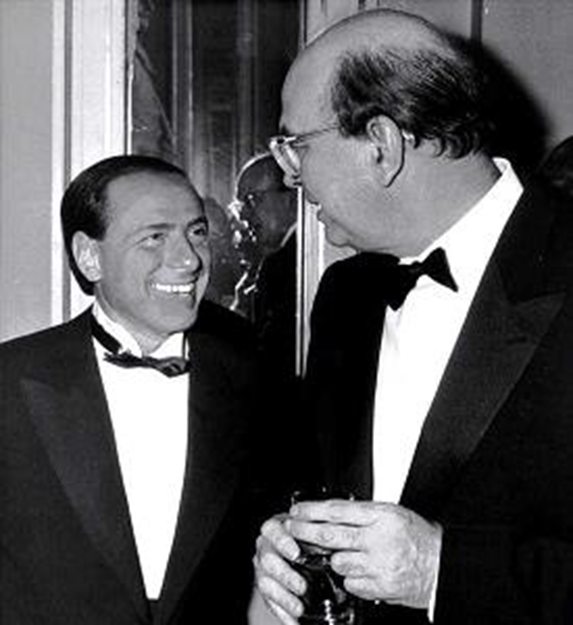
Figure 1 depicts Prime Minister Bettino Craxi and businessman Silvio Berlusconi at a social event, captured mid-exchange whilst facing one another, creating, thus, a visual order which represents them as peers. Craxi looks composed, and his body is slightly turned, projecting a calm demeanour. Conversely, adopting an attentive posture, Berlusconi is facing him with a convivial smile. Indeed, looking closely at this image, power is represented as closeness and familiarity. In fact, the picture’s framing places the Milanese entrepreneur, although still outside of politics, in the same field of recognition as Craxi, signalling his inclusion in the system of power and corruption that defined the last decade of the Prima Repubblica. Corduwener (2023) claims that Craxi’s Socialist government betrayed its Marxist ideals by adopting reformist and clientelist policies by engaging in an extensive partnership with Italian entrepreneurship (p.209). Exemplary of this phenomenon is his protection of Berlusconi’s TV networks from RAI’s legal pressures, for instance, with the so-called “Berlusconi decree” in 1984, which legalised Mediaset national broadcasting, while the Mammì Law in 1990 significantly reduced RAI’s monopoly over the nation’s media environment (Open Society Institute, 2005). Overall, Figure 1 indexes the emergence of a hybrid, that is to say, a private-public sphere shaped by commercial interest, where Berlusconi is portrayed as Craxi’s intimate interlocutor. In the background, the mirror has an essential anticipatory function as it reflects the Prime Minister’s figure on its fragile surface, foreshadowing the moment when exposure will shatter his authority and lead to his own capitulation during the highly televised Mani Pulite trial.
Mani Pulite and Judicial Exposure
Openness, Transparency, and the Performance of Justice
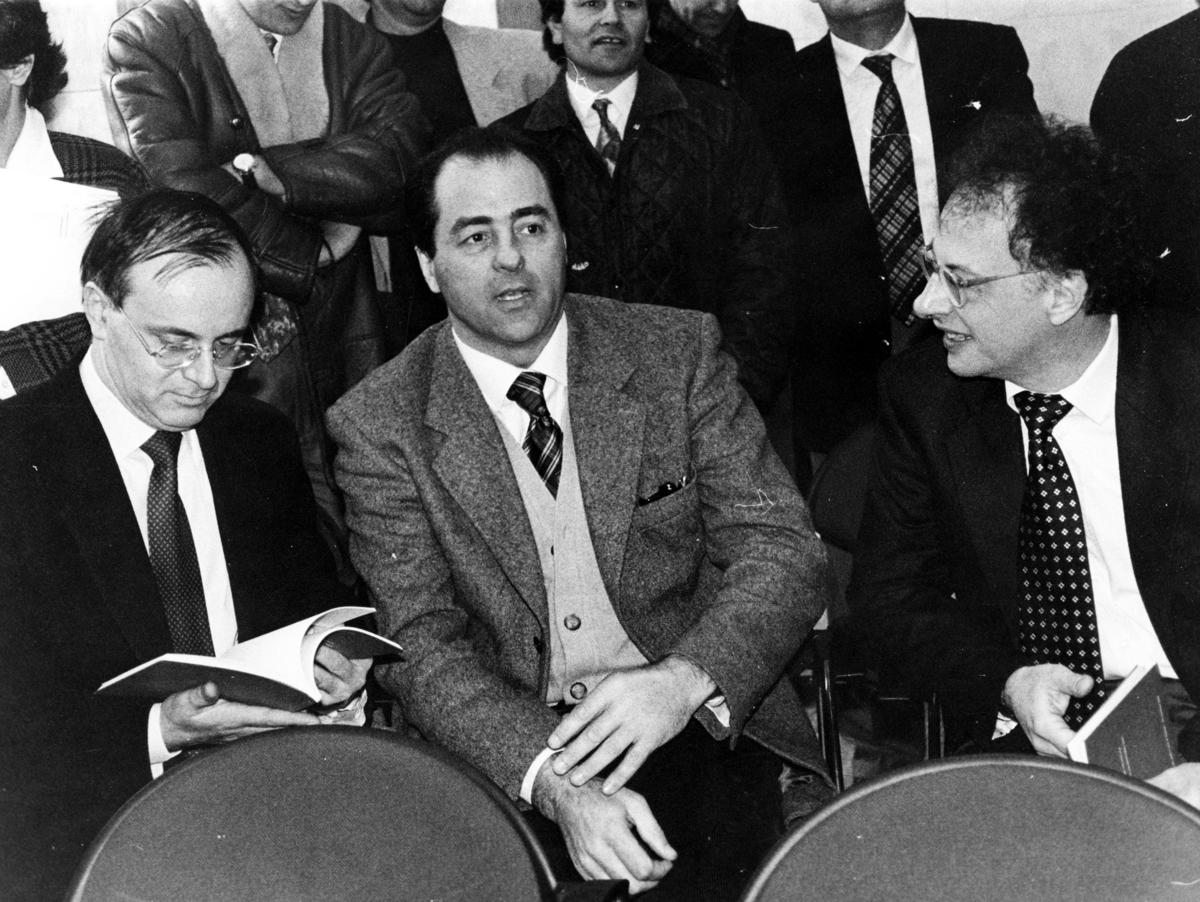
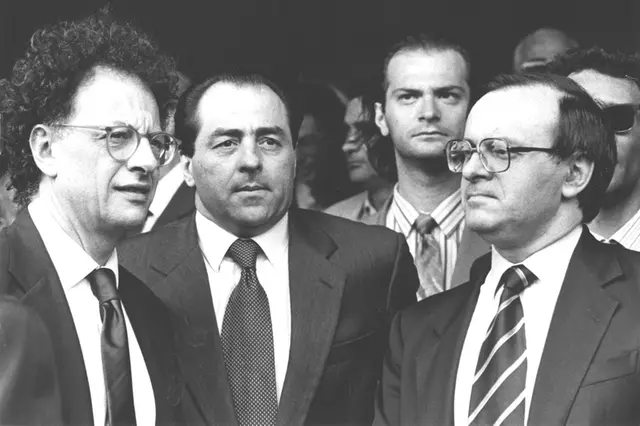
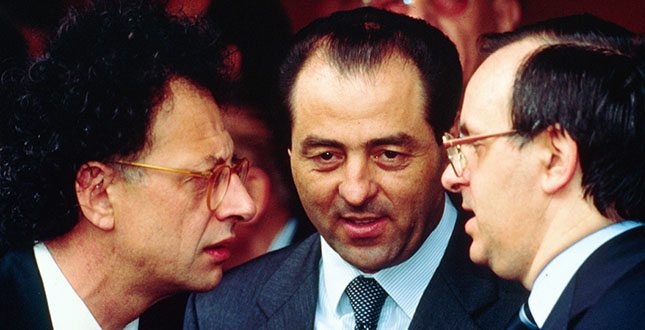
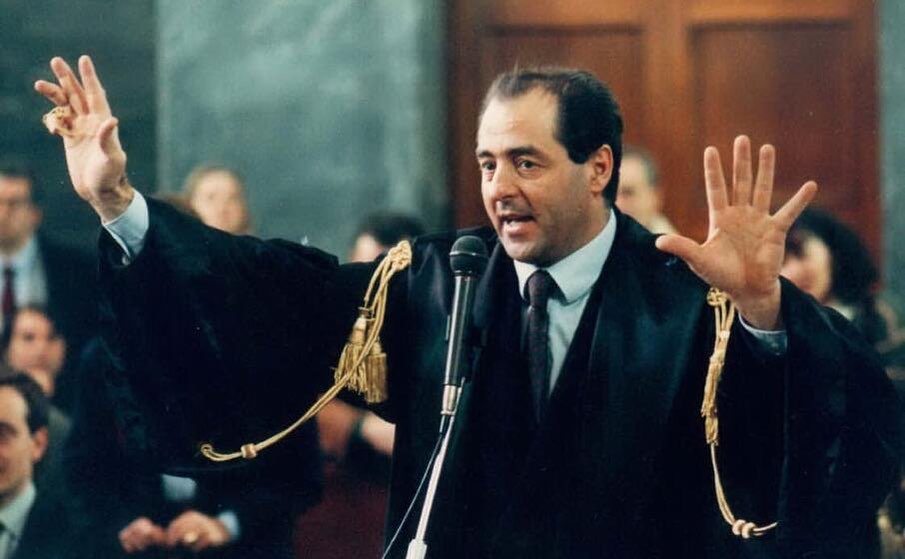
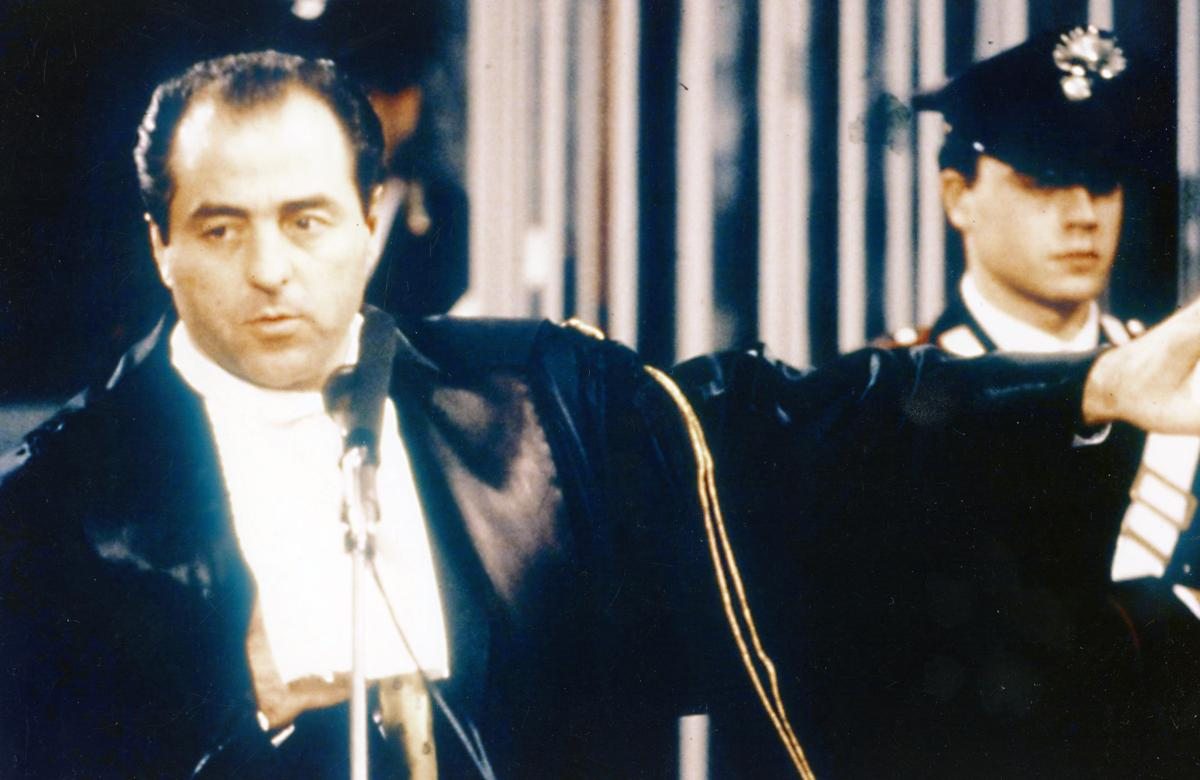
Figures 2, 3 and 4 must be read as a series rather than in isolation. They constitute a cluster of images that portray Antonio Di Pietro during the Mani Pulite trial, in which the signs that highlight his significance as a public figure emerge and gain meaning through repetition. On closer inspection of this set of images, the observer will notice how his position and gaze recur with regularity. Indeed, in these pictures, the prosecutor is always placed at the centre, as the protagonist, and between his senior magistrates, Gherardo Colombo and Piercamillo Davigo. Additionally, his gaze is always projected forward beyond the captured setting and towards the future. Unlike his two counterparts, his outward-facing gaze produces an affective connection between him and the public, abstracting him from the bureaucratic and institutional role, and turning him into a medium of affect through which hope for change can be imagined. The recurrence of this indexical logic suggests that Di Pietro’s role has moved beyond the traditional judicial context and is now perceived as a mediatised embodiment of collective hope. This is corroborated by the fact that, following the trial, he transitioned into politics by creating and becoming a leading figure of the Italia dei Valori (Italy of Values) party (Kellman, 2025). Strassler (2020), drawing on Jodi Dean, suggests that openness functions as an effective hegemonic tool within democratic settings. Indeed, the commodification of secrets and scandals plays a central role in engineering civil society into an ideal collective consumer to whom nothing should be hidden (p.100). Accordingly, transparency becomes a mechanism of control by setting in motion mediatised processes of exposure that maintain the illusion of a fully open democratic public sphere in which everything is disclosed. Within this context, Mani Pulite’s uncovering of corruption can be viewed not only as an evidentiary phenomenon but also as a performative one. In both Figures 5 and 6, Di Pietro is highly gestural, expansive, and grandiose; in Figure 6, the brightness of the light engulfs his image, producing a quasi-mystical layer that separates him from the other elements within the picture. These images suggest how, during the trial, the judicial procedure was distorted into a moral drama. Indeed, citizens were targeted as spectators whose affective investment sustained the spectacle of justice.
Berlusconi and the Rise of The Second Republic
Image-Event, Spectacle, and the Mediatization of Italian Politics

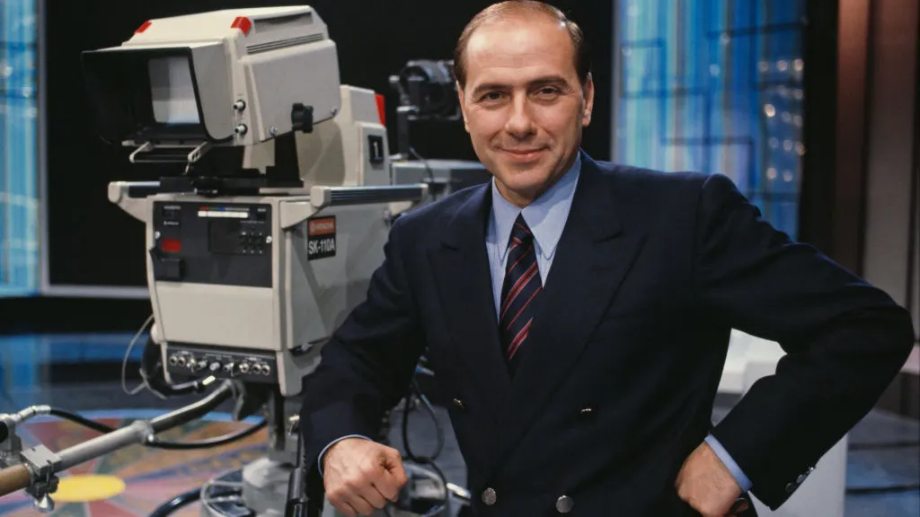

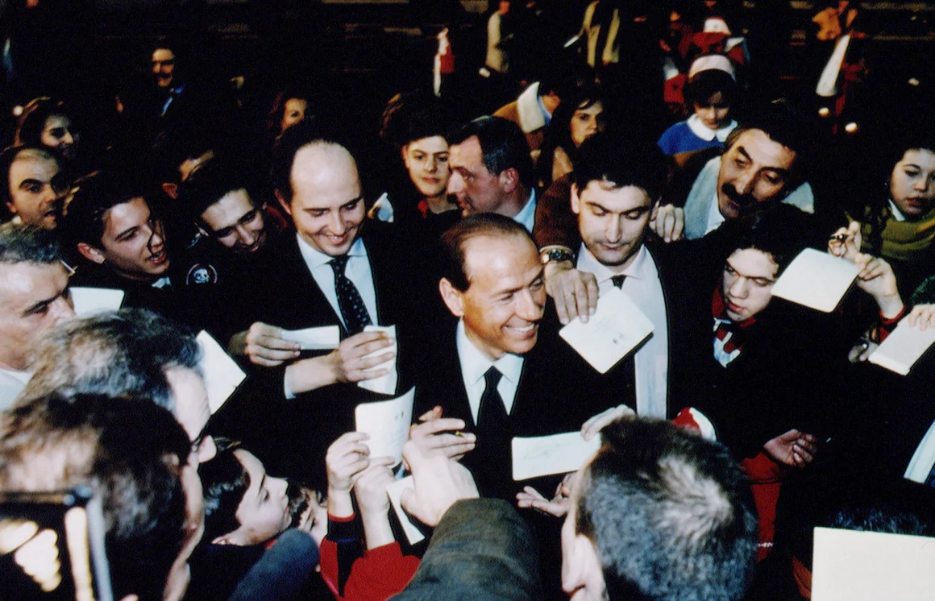
Across the images marking Silvio Berlusconi before and during his entry into politics, power is not attached to the state or party structures, given the recent decline of the Italian political establishment. These pictures that I will be analysing materialise the political-economic shift of Italian democracy, where mediatisation, consumption and affect become the primary conditions of political authority. In Figures 7 and 8, Berlusconi is depicted within one of his network studio environments, in the first case leaning onto the TV and in the last case standing beside television cameras. He appears to be in control and relaxed within the media environment. In fact, he is portrayed as a professional already at home with the tools and within the infrastructure of broadcasting. What makes these images crucial is how power is positioned within the spaces of visual production and distribution. Additionally, the picture in Figure 9 strengthens this thesis. It is a video still extracted from the announcement of his Discesa in Campo (entry into the political arena), which was broadcast in January 1994 across Berlusconi’s private networks. This address to the nation was staged within his own domestic context at Villa Arcore, where he is portrayed seated at his desk, surrounded by soft lighting, bookshelves, and family photographs. This announcement, which was initially recorded on a 9-minute video cassette tape, was circulated on public television, for instance TG1 on RAI, as well as in domestic and foreign newspapers, such as Reuters (Ginsborg 2004, p.65) and has made it one of his most recognisable images. The concept of image-event provides a framework for understanding this picture. These images capture a specific moment in time by the way they circulate and organise collective popular discourse across different media platforms (Strassler 2020, p.13). The political effect of the Discesa in campo stemmed from its viral saturation of the media environment, which allowed Berlusconi as a political persona to be consumed and recognised by electors. However, while Strassler (2020, p.16) emphasises how these images incite active public visual engagement, the domestic character of Figure 9 instead activated an affective logic based on familiarity. In fact, Berlusconi addresses the audience not as potential voters but as customers already used to his presence, since they all have TVs in their homes and consume his products in their daily lives. Here, Guy Debord’s (2006) conceptualisation of the spectacle becomes central, since he states that it is a system of appearances which determines reality by assuming a visual form that asserts its dominance over all social life (pp. 13-14). He argues that capitalism is no longer structured around productivity and possession but is organised around the appearances of its accumulated commodities (p. 16). In contrast to early capitalism, when the leisure of the working masses was disregarded by the ruling class, the rise of the Second Industrial Revolution and the saturation of society with commodities transformed leisure into a central mechanism of mass social control. Consumption, thus, becomes the principal site of alienation (pp. 29-30). Debord further claims that the fetishistic character of the spectacle disguises the real power relations that support it by presenting them as objective and neutral, thereby masking its role in reproducing domination (p.19). As a result, in these images, Berlusconi's image appears as a commodity, and his constant exposure becomes the mechanism through which power is exercised and reproduced. In this context, politics operates in a world organised around visual representations, where political actors become the product, and citizens are turned into consumers. Figure 10 shows a crowd surrounding Berlusconi during his political campaign. In this image, the public gathers around the future Prime Minister as an audience seeking recognition. In fact, they are holding small pieces of paper (most likely autograph requests), pointing towards him at the centre of the frame, signifying a relationship which is centred on fame. This image dissolves the distinction between political authority and celebrity in Italian politics because the crowd’s actions mirror the behaviour usually directed at entertainers. This reflects Mazzoleni and Schulz’s (1999) argument that electors have become passive consumers, and their voting behaviour is influenced by media logic. Their notion of mediatization indicates that political processes lose their autonomy by becoming dependent on the commercial formats and aims of mass media organisations (p. 251). Drawing from all these theoretical considerations, these images must be read as a material expression of a spectacularised political context. They essentially represent the form reality takes in a system based on visibility and its consumption. This is reinforced by Berlusconi’s control over printed media, which allowed him to shape the public sphere through other forms of commodified visibility. Exemplary is his indirect power over Arnoldo Mondadori Editore (headed by his daughter Marina Berlusconi), which gave him effective control of one of Italy’s largest press and publishing groups and granted him a monopoly over almost all the means of communication (Reporters Without Borders, 2003). This corporate reach included widely circulated weekly celebrity culture magazines such as Chi (Who) and Tv Sorrisi e Canzoni (TV Smiles and Songs). Accordingly, his media dominance became a key factor in the rise of entertainment culture, with Italians increasingly devoting their leisure time to television and increasing their viewing by 24% in only seven years, between 1988 and 1995 (Newell 2019, p.135). Berlusconi ended up winning the 1994 elections, becoming the longest-serving Prime Minister and setting up a neoliberal political establishment based on private interest and commercial logic.
Gendered Visual Culture and the Spectacular Scandal
Commodified Women and the Political Authority of Masculine Desire
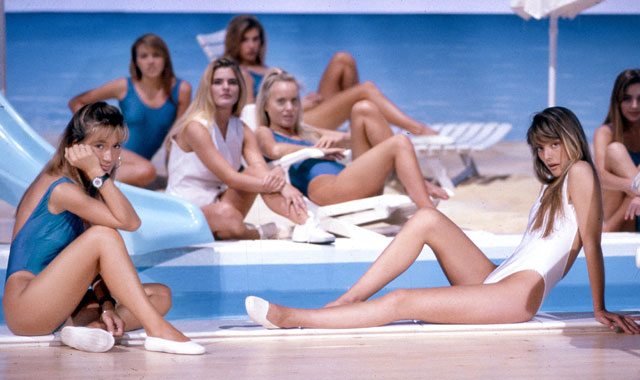
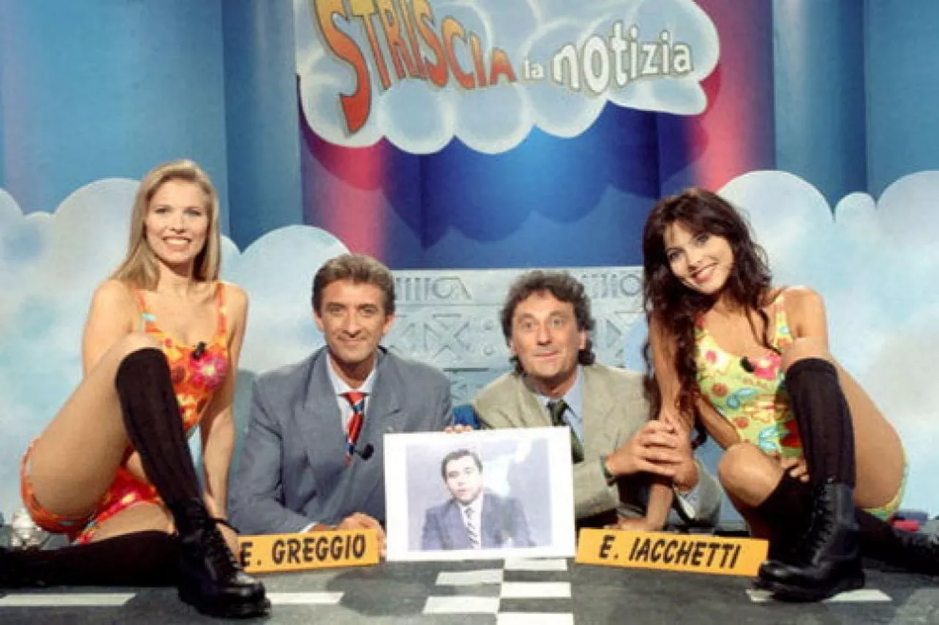
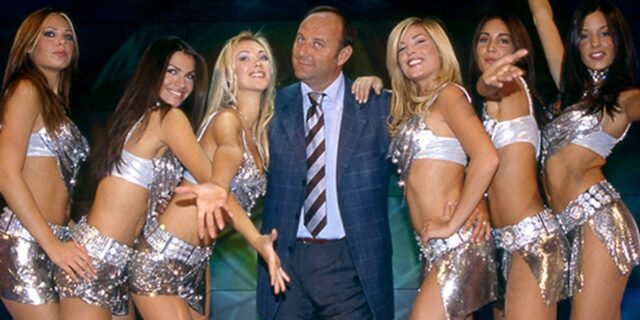
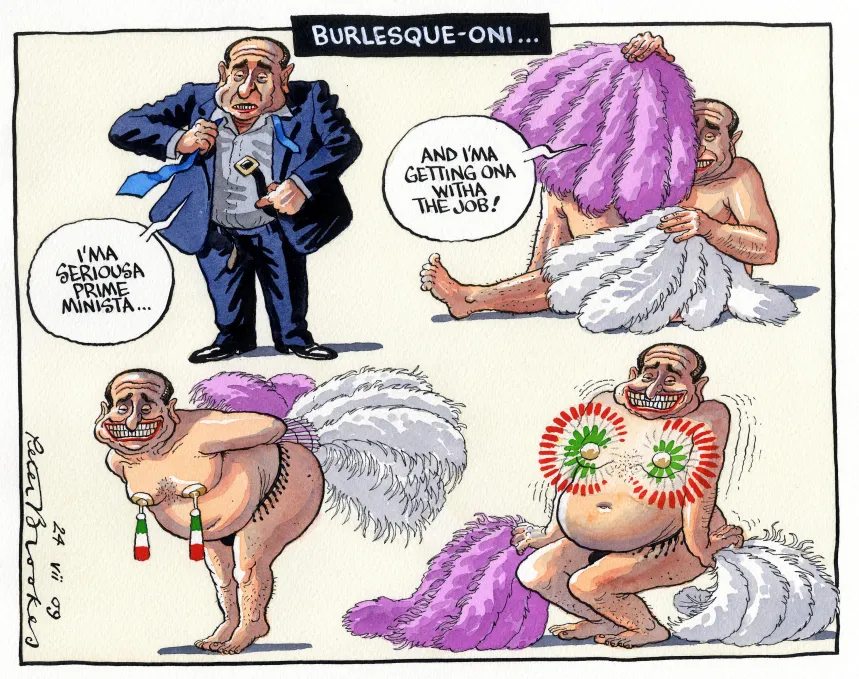
Thanks to his media empire and newly acquired political power, Berlusconi managed to create a populist regime around his image as well as his desires. It will be of interest to understand how his male-driven and carefully crafted charisma helped fuel a toxic visual culture that propelled the Italian public sphere into the 21st century. Drawing on Naomi Wolf, Hipkins (2011) discusses how women who enter the public sphere are commodified and constrained by neoliberal power’s beauty standards (pp. 418-419). Hence, who are these beauty standards supposed to satisfy, and how do they function within this organisation of visibility? Figure 11 is a still taken from a 90s Mediaset variety show called Non è La Rai (It’s not RAI), and it depicts a male fantasy world in which only young and conventionally attractive women's bodies exist. The young women’s gaze moves beyond the frame by directing their attention towards an absent but cardinal figure, namely the male viewer. The setting is purposefully designed to satisfy the spectator, whose function is to look and consume these bodies as erotic commodities. The value of their bodies is generated by the camera framing, which invites the male audience to engage in a perverted act of consumption, namely, to scan the scene and visually possess them. This logic is reinforced in Figure 12, which is an image from Striscia La Notizia (The News Slithers), a popular Mediaset satirical news show. Here, the two male presenters, Ezio Greggio and Enzo Iacchetti, who occupy the centre as speaking subjects, are dressed in respectable suits while the Veline (Showgirls) sit by their side as a silent spectacle. Their only purpose is to display their bodies, dance, and smile. Feminine presence is viewed as decoration, and masculine authority is coded as voice and professionalism. On the right, Enzo Iacchetti’s hand grabbing the showgirl’s arm signifies entitlement to her body, and it could also be read as a gesture that makes the television studio into a space where female bodies are controlled. In this picture, beauty standards are represented as a form of discipline in which women’s bodies must be visible and available to the spectator’s gaze. In Figure 13, these power relations are intensified by creating a fantasy where a male everyman is placed at its centre. The image depicts a Mediaset quiz show, Passaparola (Word of Mouth), where the presenter, Gerry Scotti, who is standing at the centre, is hugging and is surrounded by a group of women. Indeed, with their gaze toward the camera and their bodies clustered around him, the showgirls lend the photo a haptic charge that invites the male spectator to identify with him. Thanks to the synesthetic effect of this image, Scotti becomes an avatar through which the spectator can inhabit the scene. Therefore, to respond to the previous questions, neoliberal beauty standards are designed for a commercialised male gaze and female bodies, within Berlusconi’s system, become a medium, or better, surfaces invested by male desires as well as visual representations of masculine dominance that are sold back to the viewer. Furthermore, since the Italian audience had already been conditioned to this gendered visual culture within entertainment, Berlusconi tried to mediatise both Italian and European politics by adopting the same sexist and patriarchal logic just described. However, on the 3rd of May 2009, his then-wife, Veronica Lario, through a press release, announced her decision to divorce him by condemning his infidelity, but most importantly, by denouncing his party’s intention to include some of his television actresses and showgirls among the candidates of the upcoming European elections. In her statement, she framed this decision as a public humiliation for women. In fact, she claimed that such an action diminished women’s intellectual and political credibility by reducing their value to physical appearance and appeal (Gundle 2009, p. 59). This intervention marked a rare moment in Berlusconi’s media culture, as it represented an open challenge from within his private and domestic context. Shortly after, a paparazzo named Antonello Zappadu, equipped with long-range lenses, captured thousands of photographs of Berlusconi and his guests in his private residence of Villa Certosa in Sardinia (p. 61). The images in Figure 14 depict the Prime Minister surrounded by escorts, who are sunbathing or entertaining one of his guests during private gatherings. Strassler (2020) claims that the exposure of secrets in evidentiary images generates a sort of concern for truth and activates the affective pleasure of revelation within the public (pp. 107-108). However, these images, rather than producing a need for clarity and initiating a process of political accountability, take on a voyeuristic form. Indeed, considering the misogynistic logic of the media sphere in question, these photographs operated within a system of visibility that transformed what in other contexts would have been considered exposure into a spectacle. The scenes mirror the previously analysed imagery of his television networks, in which the man (in this case, Berlusconi himself) appears as a figure of power, while the women signify availability and are represented as decorative presences to be desired. In simple terms, the scandal’s destructive effects are absorbed by the power of the spectacle. Zappadu’s photos had a short-lived life in Italy, since the Garante per la Privacy (the Italian State Data Protection Authority) censored the publishing of these images on the grounds that they were infringing the Prime Minister’s privacy, as the events captured were within his private property (Garante per la protezione dei dati, 2009). Later, these images resurfaced in the international press, specifically in the Spanish newspaper El País, which triggered a wave of commentary across global media outlets, including The Times, where Berlusconi was widely criticised and ridiculed, as can be clearly observed in Figure 15 (Gundle 2009, pp. 61,63). Conversely, the Italian press, which was influenced by Berlusconi’s power over both public and private media outlets, minimised the coverage of the Villa Certosa by reducing it to a simple private matter (p.64). Although Berlusconi witnessed a drop in political support, there was widespread sympathy for him, who was perceived as a vigorous man in his seventies still sexually active with young women (p.72). Ultimately, this event reveals that, within a neoliberal, mediatised political regime organised around a singular, hyper-visible man, exposure does not function as a corrective to power but as its main principle.
Conclusion
The selected public images were employed as indexical media to uncover the hegemonic processes behind the major political shift within the Italian establishment towards the end of the 20th century. In fact, this imagery records the dissolution of the Prima Repubblica as well as the conditions that led to the transfer of power that made the Seconda Repubblica possible. By focusing on the image of Prime Minister Bettino Craxi with the then media tycoon Silvio Berlusconi, I argued that it captures a moment in history characterised by patronage and policies of privatisation, where political authority, together with entrepreneurial capital, set the foundations for the constitution of a neoliberal hegemony and the rise of commercial media conglomerates. I further showed how the images surrounding the highly televised Mani Pulite trial reveal how this transformation was already underway before Berlusconi’s entry into politics. Antonio Di Pietro’s noticeable presence at this event signals the alignment of the judicial process with the logic of spectacle by exploiting the Italian public’s demand for openness through performativity. I maintain that, within this context, the rise of Berlusconi appears as a continuation of an already mediatised political environment. The selected images show how his visibility was commodified by repositioning the Italian elector as a spectator and subjecting politics to the same visual logic of entertainment. Additionally, I argued how the visual representation of women within Berlusconi’s media empire played a cardinal role in normalising a sexist visual culture within the nation. Indeed, Zappadu’s photos circulated, although briefly, within a public sphere already used to this gendered visual order, thereby collapsing their revelatory utility into a familiar economy of virility and spectacle. This scandal reveals the limits of transparency within a neoliberal media order that regulates the circulation of images and shapes their public reception. To conclude, this essay traced a trajectory of power, which, in the moment of crisis, reorganised itself by operating in full visibility through the very mechanism of exposure that sustained it. The Berlusconi phenomenon examined extends beyond the Italian context and functions as a matrix for understanding contemporary hegemony. Figures such as U.S. President Donald Trump are reminiscent of Berlusconi, especially in how their images rely heavily on visibility. For instance, the scandals that followed the January 6th Capitol attack failed to destroy his political credibility within the American electorate and culminated in his return to the presidency in 2024. In recent times, his press conferences following his administration's military operation in Venezuela and his unapologetic expansionist rhetoric aimed at Greenland demonstrate how his media presence reifies American imperialism by reducing it into a spectacle for global consumption.
Bibliography
- Accornero, P.G. (2017) ‘Tangentopoli, un quarto di secolo dopo la posizione della Chiesa’, BergamoNews, 18 February. Available at: https://www.bergamonews.it/2017/02/18/tangentopoli-un-quarto-di-secolo-dopo-la-posizione-della-chiesa/246400/
- Affaritaliani.it (2022) ‘Di Pietro: “Non è cambiato nulla, prima di morire metto Mani Pulite in rete”’, Affaritaliani.it, 17 February. Available at: https://www.affaritaliani.it/cronache/di-pietro-non-e-cambiato-nulla-prima-di-morire-metto-mani-pulite-in-rete-780858.html?refresh_ce
- Alibani, N. (2022) Silvia Toffanin, Ilary Blasi e le altre: dai tempi delle “Letterine” a oggi. Available at: https://www.robadadonne.it/lista/silvia-toffanin-ilary-blasi-letterine-passaparola/
- Arcolaci, A. (2024) ‘Il giovane Berlusconi, quando la mamma gli diceva “Tu hai il fuoco nel cervello”’, Vanity Fair Italia, 13 April. Available at: https://www.vanityfair.it/article/il-giovane-berlusconi-quando-la-mamma-gli-diceva-tu-hai-il-fuoco-nel-cervello
- Barbacetto, G. (2025) ‘Milano, è partito tutto da un cortile come col mariuolo Chiesa’, Il Fatto Quotidiano, 20 July. Available at: https://www.ilfattoquotidiano.it/in-edicola/articoli/2025/07/20/milano-e-partito-tutto-da-un-cortile-come-col-mariuolo-chiesa/8067494/
- Colonna, M. (2023) Programmi Amarcord – Non è la Rai. Available at: https://www.mimicolonna.it/amarcord-non-e-la-rai/
- Corduwener, P. (2023) “The Italian Socialist Party and the crisis of party democracy. The transformation of the Italian socialists,” Journal of Modern Italian Studies, 28(2), p. 209. Available at: https://doi.org/10.1080/1354571X.2022.2073419
- Debord, G. (2006) The Society of the Spectacle. Translated by D. Nicholson-Smith. New York: Zone Books.
- Di Donato, V., Lanza Nadeau, B., Smith-Spark, L., Wilkinson, P., Mortensen, A. and Picheta, R. (2023) ‘Silvio Berlusconi, Italy’s former showman leader, battled a string of scandals to dominate politics for decades’, CNN World, 12 June. Available at: https://edition.cnn.com/2023/06/12/europe/silvio-berlusconi-italy-death-obituary-intl
- El País, cited in la Repubblica (2009) ‘Le foto di Villa Certosa pubblica da El País’, la Repubblica, 5 June. Available at: https://www.repubblica.it/politica/2009/06/05/foto/le_foto_di_villa_certosa_publica_da_el_pais-24659365/6/
- Garante per la protezione dei dati (2009) Foto Villa Certosa: il Garante richiama al rispetto delle regole - 5... - Garante Privacy. Available at: https://www.garanteprivacy.it/home/docweb/-/docweb-display/docweb/1619654
- Ginsborg, P. (2003) Italy and Its Discontents. New York: Palgrave Macmillan.
- Ginsborg, P. (2004) Silvio Berlusconi: Television, Power and Patrimony. New York: Verso.
- Gundle, S. (2009) Berlusconi, Sex, and the Avoidance of a Media Scandal, Managing Uncertainty. Available at: https://www.jstor.org/stable/43486438?seq=1&cid=pdf-reference#references_tab_contents
- Hallin, D.C. and Mancini, P. (2004) Comparing media systems: three models of media and politics. Cambridge: Cambridge University Press.
- Hipkins, D. (2011) “‘Whore-ocracy’: Show Girls, the Beauty Trade-Off, and Mainstream Oppositional Discourse in Contemporary Italy”, Italian Studies, 66(3), pp. 413–430. Available at: https://doi.org/10.1179/007516311X13134938224529
- Kellman, J. (2025) Antonio Di Pietro | Biography & Facts | Britannica. Available at: https://www.britannica.com/biography/Antonio-Di-Pietro
- Lenzi, R. (2011) ‘Craxi e Berlusconi’, La Letteratura e i Fatti – Domani, 26 December. Available at: https://domani.arcoiris.tv/ho-una-strana-nostalgia-per-craxi-con-lui-non-saremmo-ridotti-cosi/craxi-e-berlusconi/
- Magnum Photos (2023) Silvio Berlusconi in the studios of his Italian television network, Canale 5. Milan. Italy. 1986., Facebook post, 12 June. Available at: https://www.facebook.com/photo.php?fbid=813588530126794&id=100044269637521&set=a.800129431472704
- Mazzoleni, G. and Schulz, W. (1999) “‘Mediatization’ of Politics: A Challenge for Democracy?,” Political Communication, 16(3), pp. 247–261. Available at: https://doi.org/10.1080/105846099198613
- Newell, J.L. (2019) Silvio Berlusconi: A Study in Failure. Manchester: Manchester University Press.
- Open Society Institute (2005) Television across Europe: regulation, policy and independence Italy.
- Reporters Without Borders (2003) A media conflict of interest: anomaly in Italy | RSF. Available at: https://rsf.org/en/media-conflict-interest-anomaly-italy
- Repubblica.It (2016) 'Striscia la Notizia, amarcord veline. E Canalis su Instagram: ‘Ecco com’eravamo,’' La Repubblica, 30 June. Available at: https://www.repubblica.it/spettacoli/tv-radio/2016/06/30/foto/striscia_la_notizia_tutte_le_veline-143125722/1/
- Schofield, B. and Brookes, P. (2023) 'Silvio Berlusconi’s scandalous life in cartoons,' The Times, 13 June. Available at: https://www.thetimes.com/world/europe/article/silvio-berlusconis-scandalous-life-in-cartoons-527x60g5k
- Strassler, K. (2020) Demanding Images: Democracy, Mediation, and the Image-Event in Indonesia. Durham: Duke University Press. Available at: https://doi.org/10.1215/9781478005544
- Wikipedia (n.d.) ‘Ingresso in politica di Silvio Berlusconi’. Available at: https://it.wikipedia.org/wiki/Ingresso_in_politica_di_Silvio_Berlusconi#/media/File:Discesa_Berlusconi.png
- Wikiwand (n.d.) ‘Antonio Di Pietro’. Available at: https://www.wikiwand.com/it/articles/Antonio_Di_Pietro