Introduction
Brick Lane is a well-known street in the East London borough of Tower Hamlets that has long been a place of arrival for diasporic communities settling in the city. Initially inhabited by Irish migrants, it was later settled by the Jewish community and, from the 1960s onwards, became the centre of the Bangladeshi community, which had migrated largely from Sylhet, Bangladesh. Over the last 20 years, the area has undergone considerable transformation, and community members have responded differently. For some, it feels like a loss, while for others, it feels like a positive improvement. Therefore, the meaning of Brick Lane today is contested within the Bangladeshi community and is not, as many might think, uniformly understood as a story of loss through gentrification. My regular engagement with the community members challenged this common assumption and redirected the focus of this project. As a result, Memories of Brick Lane avoids imposing a political argument on gentrification and instead focuses on the Bangladeshi community and its memory of the street as its main subject. In order to do so, I wanted to explore how memory shapes a sense of who they are while the place they know is progressively changing around them. However, it is important to note that the earlier presence of the other diasporic groups I mentioned belongs to a longer history of Brick Lane and will not be part of this inquiry, since the scope of my study is limited to the perspective of the Bangladeshi community and not the layered history of the street as such. Since cultural memory belongs to a particular group and provides that group with its sense of self, it follows that an inquiry into memory will always be specific. In fact, in this paper, I will draw on Stuart Hall (1994) to argue that cultural identity in diasporic communities is shaped by temporal and cultural factors, making it a process of becoming. Accordingly, I will draw on Jan Assmann (2015) to argue that memory sustains this process, since it is through memory that a community holds its past and present together and thus understands itself across time. I sought to avoid producing a film that functions as a record of something finished; instead, I wanted to portray this living memory at work and to let the film enact this dynamic in its form.
Memories of Brick Lane began with the friendship of my colleague Abdul, who spent his youth frequenting Brick Lane and would always tell me stories of the community and the street as it had been, and my curiosity about the place grew from the contrast between my colleague’s memories of the area and its present appearance. As a result, I became interested in how the Bangladeshis would relate to the tension between the past and present in one of their most famous living spaces. With Abdul’s help, I spent over a month conducting fieldwork in Brick Lane, returning regularly to speak with community members, asking each of them the same two things: their memories of Brick Lane and how they feel about the street today. In the movement between the two answers, I would sometimes find a continuity and sometimes a tension that would constitute the substance of my fieldwork. For instance, an elder who arrived in the late 1960s recalled, through Abdul’s translation, the hardships of those early years, from the crowded flats and the skinheads who waited on the streets to harm them, which he set against a present which he regards as better, as the area is now safe and Bengali people now have access to good jobs and some of them work in the council, which provides a sense of security that according to his testimony was lacking before. Another example is that of a restaurant owner I met, whose family turned a former tailoring factory into a curry house in the early 90s, who fondly remembered the Brick Lane of his youth in the 1980s as the hip and coolest place to be for young Bengalis, and described how the restaurant business flourished around the 2000s until rising rents began to make sustaining a business on the street very difficult. Lastly, a grocer with his younger nephew beside him traced the whole arc of the diaspora on the street, from the fathers who came first and the families who followed, to the tailoring and garment businesses that were successively replaced by import businesses, groceries, and restaurants. He then explained that rising costs and gentrification have since pushed the majority of residents and traders towards other parts of London, and the nephew added that what remains of Bengali Brick Lane will, sooner or later, be gentrified. These are examples of accounts I collected during my fieldwork, and, as the reader might observe, there are contrasting perspectives among members of this diasporic community, which underscores how cultural identity cannot be reduced to a single view. From this wider fieldwork, the film draws two perspectives and testimonies, those of my friend Abdul and Rahman, an elder involved in the mosque and a member of its committee, who both agreed to be filmed and whose accounts I will present and discuss later in this paper. The film makes no claim to speak for the community as a whole, as it focuses on two particular views within its totality. It is important to note that I approached this community as an outsider, since I share neither its faith nor its language, although I was drawn to its members as a migrant myself, interested in the lives of displaced people from their country of origin. The film also lacks a female perspective, which proved very difficult to access, and this absence excludes a very important and constitutive dimension of how memory shapes cultural identity within the community. Therefore, the film offers a limited and situated account, and the position from which it is made, including my own, is part of what the dissertation examines. To conclude, through this dissertation, I will examine how memory shapes diasporic identity in the context of urban transformations and how these concerns informed the film. The chapters that follow will provide the necessary conceptual framework for analysing the film.
Theoretical Framework
In his essay “Cultural Identity and Diaspora”, Stuart Hall begins by observing that “we all write and speak from a particular place and time, from a history and culture which is specific” (1994, p.392). He demonstrates this principle on himself before applying it to anyone else, situating himself within the discourse of cultural studies as someone born in Jamaica in a lower middle-class context and who lived his adult life in England, in the shadow of the black diaspora. Following his gesture, I want to state my own position at the outset. I am a black Italian from a working-class context, the son of Ghanaian parents who left their country for Italy, and I now live in England. I write about the diasporic community as a child of the diaspora myself, situating this project within the cultural studies discourse. This proximity is partial because my experience of diaspora differs from that of the community I filmed in terms of faith, language and history. Yet, if all discourse is placed, as Hall claims, then my position shapes what I am able to see and say about this community, and reflexivity means keeping this fact in view. As a result, my position runs throughout the dissertation and appears at three moments in the film. However, positioning is more than a methodological point in Hall’s essay, as his account of cultural identity is grounded in it. The Jamaican theorist identifies two ways of thinking about cultural identity. In the first, identity is a shared essence, a true collective self that people hold in common. In the second view, which he finds less familiar and unsettling, a shared culture contains, alongside its many points of similarity, deep and significant differences and historical factors that characterise and determine how a community perceives itself. In this sense, cultural identity is “a matter of ‘becoming’ as well as of ‘being’. It belongs to the future as much as to the past” (Hall 1994, p.394). It follows that, contrary to a common-sense perception of identity as an essence, namely a fixed origin to be recovered, it is a process in constant construction throughout time. Indeed, he observes that a community’s past cannot simply be accessed, since some form of break always stands between a people and what came before (Hall 1994, p.395). Although Hall understands this rupture primarily in terms of diasporic displacement, my project suggests that a comparable break emerges through the transformation of Brick Lane itself. For the community in my film, the break lies between the Brick Lane as they knew it and the one that exists today. Therefore, access to that earlier Brick Lane depends on memory, and what it delivers is a constructed past, assembled in the act of recalling it. Identity, then, takes shape in how a community positions itself towards the past, and since the past exists through memory, memory is constitutive of identity itself. This positioning also accounts for difference within a community, since each member stands in a particular relation to its past. Thus, to belong means to hold a specific position, and the differences between those positions are part of what its identity contains.
Since Hall establishes that a community’s identity is built from its remembered past, it will be of importance to explain how remembering constitutes it. Accordingly, Jan Assmann’s (2015) account of memory becomes central, as he argues that memory is a faculty that enables people to construct narratives or images of the past and, thus, to develop a sense of self (p. 328). Assmann distinguishes memory as its own form of knowledge from knowledge in general, since memory alone carries a relation to the self, which he calls the identity index. To explain how the construction of the past, together with the development of the self, occurs through the same process, he introduces the notion of the autonoetic (from the ancient Greek self-cognition) function of memory. The latter is a form of cognition that generates awareness of ourselves over time, thereby allowing human memory to synthesise time and identity, which he identifies as diachronic identity (p.329). He specifies that this synthesis operates both at the individual and the collective level, so that the same faculty which gives the subject a sense of self across time gives a community a sense of itself across generations. It follows that memory is an essential function for both individual and collective identity, since it enables people to locate themselves within specific communities across time. In my film, this dynamic is explored through the personal testimonies of Bangladeshi community members who draw on autonoetic memory to articulate a diachronic identity, that is to say, a sense of who they are that persists even as the environment is changing around them. For this reason, every conversation in the fieldwork and in the film turned on the same two requests, namely to share memories of Brick Lane and feelings about the street today. Furthermore, Assmann notes that “autobiographical memory is a social construction that we build up in communication with others” (p.328), which makes testimony spoken to another person a fitting site for observing memory at work.
After having established what memory does, the only thing remaining to clarify is where it happens. Edward Casey (2000) claims that remembering is always carried out by an embodied being, and that to be embodied is already to occupy a particular perspective or position, since a body is always situated in a place from which it experiences and remembers (p.182). Indeed, our experiences happen in particular places, and the memories we form are bound to those places rather than floating freely in our imagination. A memory that is unplaced, according to Casey, would be a kind of anomaly because it would require a disembodied memory, which would contradict a constitutive element of how memory works. He supports this by observing how rare placeless memory actually is, as we almost always remember a place itself, or people and events set within a place, and struggle to recall anything without a location attached to it (p.183). As a result, place is what situates our memorial life and gives each memory somewhere to belong (p.184). Casey then makes the point that matters most for Memories of Brick Lane, namely that memory and place depend on each other in both directions. On one hand, a place draws out particular memories rather than others, so that being in a specific location brings back what happened there and not just anything. On the other hand, and more fundamentally, memories attach themselves to particular places, congealed into scenes, so that the place itself comes to hold and preserve what we remember of it (p. 189). A place, in this sense, is a container in which the past sets and remains available to be read. This idea shapes how the film is shot, since, alongside the testimonies, it repeatedly returns to fixed shots of particular places in Brick Lane. Filmed this way, these places are treated as Casey’s congealed scenes, that is to say, as surfaces on which memories have attached or will attach themselves, so that a shopfront or a stretch of wall becomes a holder of memory.
The Form of the Film
The previous chapter set out the framework through which the subject of Memories of Brick Lane is to be understood. Conversely, this chapter turns to its form, meaning the visual theory that justifies the way the film was made. The starting point follows from Hall’s (1994) claim, which I discussed in the previous chapter, that all discourse is enunciated from a particular position. Accordingly, my film is no exception: it does not present Brick Lane as it is in itself, but as I encountered it, and what the camera registers is a representation of my perspective on the street and the people I observe. The film's structure makes this dynamic explicit. Indeed, each section is a representation of one of my memories, namely my encounter with the street itself, with Abdul, with Rahman and the return to the empty street at dawn. Accordingly, the film makes my role as the filmmaker explicit at three key moments. The first is when I direct Abdul before his testimony begins, the second is in conversation with Rahman together with a classmate, and the third comes in the conclusion, where I film my own reflection in a restaurant window. The transitions between the sections aim to represent my own memories of these encounters, since each section fades in and out before the next appears, as one remembered episode surfaces and dissolves to give way to another. However, it will be important to state that the memories the film presents belong to Abdul and Rahman and their community, while my own remembering of the encounters constitutes the form of the film, that is to say, its structure and not its subject. This declared perspective is the film’s reflexivity, which each formal choice I will discuss will keep in view.
The first of these choices concerns the sensorial register in which the film opens and closes. The intro, for instance, takes inspiration from Koyaanisqatsi (1982), a sensorial and critical exploration of the metropolis as a byproduct of industrialisation and its effects on its people. The film alternates between sequences where crowds and traffic accelerate into continuous flows, and sequences that slow them down by dwelling on individual faces and gestures within the mass. My film, however, does not accelerate anything, but I was drawn to the slow motion, since holding the city still in this way immerses the viewer in it and lets them attend to details, movements and faces that ordinary looking passes over. The purpose of these passages is to let Brick Lane be apprehended through the senses, and David MacDougall’s (2006) account of the corporeal image explains how a film can achieve this. Indeed, he argues that a film image does not represent a copy but produces a new perception of reality, and he counts slow motion as one of the techniques for achieving this effect (p. 17). Moreover, such a perception reaches the body before it reaches the intellect, since watching a film creates a continuous exchange between the screen and the viewer's bodily responses (p. 20). It follows that a film can offer the opportunity to immerse oneself in it and feel it without explanation, and this is what the opening and ending of my film provide. In Brick Lane, there are things that anyone walking there would not notice, and slowing them down holds them in front of the viewer long enough to be properly observed. Grimshaw and Ravetz (2009), drawing on Taussig, explain this effect through the concept of mimesis, in which the perceiver's body and the thing perceived merge. When this happens, the sensuous image slows reality down, meaning that dwelling on the sensory details of something familiar suspends our habitual way of looking and allows us to perceive it anew. They argue that an image received in this fashion is memorable because what reaches the senses settles in our consciousness (p. 552). Their slowing is intended as a perceptual process, but my film takes it literally, since the slow motion produces on screen the suspension of the habitual glances they describe. The images through which the viewer perceives the street in this way are the ones I attended to, so the mimesis they describe passes through my observation of Brick Lane. Sound is another means by which the film immerses the viewer, since it, too, can bring to light what usually escapes notice. While the archival photographs remain fixed, the contemporary sound of the streets surrounds the viewer, allowing present-day Brick Lane to be heard before any moving images appear.
The second choice concerns the way the testimonies themselves are filmed. MacDougall (1998) uses the notion of the unprivileged camera by contrasting it with fiction cinema camera work, which is based on what he calls the privileged camera, namely a position that would be impossible to occupy in ordinary life, as it implies an invisible and ubiquitous observer (p. 201). The editing of fiction takes similar liberties with time and space by instantly moving the viewer’s eye between positions that no ordinary person could travel between. Against these conventions, the unprivileged camera style relies on the principle that a film's appearance should be based on the actual meeting between the filmmaker and the person filmed (pp. 203-204). A film that follows this principle closely is Wang Bing’s Fengming: A Chinese Memoir (2007), which consists almost entirely of an elderly woman recounting her experience of Maoist China from a chair in her apartment, filmed from a single position and without cuts. As she speaks into the evening, the viewer sees the room grow dark around her, since Wang Bing holds the frame to avoid interrupting the account and preserve the continuity of her memory. My film follows this example in part. Indeed, this principle governs my film's framing of the two participants, since each testimony is shot in a single frontal frame, with the subjects placed at the centre and surrounded by their environment. The viewer is never offered an alternative angle of them while they are speaking. Indeed, I occupied one position during the interaction, and any other point of view would claim a presence I did not have. The frontal frame serves another purpose, since, as mentioned previously, Assmann (2015) notes that autobiographical memory is constructed through communication with others (p.328), so the testimonies function as memories built in the act of interacting with me. However, I cut to the environment in which each encounter took place, and these cutaways dwell on the place or context the participants describe. As a result, the film mixes the two conventions: the frontal frame follows the unprivileged style, while the cutaways to the environment borrow what MacDougall attributes to fiction. Therefore, the film treats these two kinds of material differently. The testimonies allow no such liberty, while the cutaways do, as they were filmed during the encounter and placed in an order of my choosing, functioning, thus, as the congealed places discussed earlier through Casey, which hold the context of each testimony as the setting of what is being remembered.
The last element of the form is the film's use of disjunction between what the spectator hears and sees. For instance, throughout the two testimonies, the viewer hears about a past Brick Lane, while seeing only the present one, and this disjunction keeps the break I discussed in the previous chapter continuously in view, since the remembered street and the present street are never available together. Laura Rascaroli (2017) employs the concept of the interstice, which, as she argues, Deleuze emphasised in his conception of cinema as a spacing between images, between sounds, and between sound and images (p. 9). She develops this notion in relation to the essay film, but she recognises that it can be used to illuminate a much broader set of practices, and my film takes up this possibility. In her account, the interstice is a space of virtual potentiality within the disjunction in which something can be created, and this coincides with an act of speculation on the part of the spectator (p.11). This is a fundamental principle behind my film's construction. Finally, the next chapter discusses how I will use archival materials in accordance with this principle.
Memories of Brick Lane
Memories of Brick Lane opens with a sequence of archival stills of the Bangladeshi community, while the sound of present-day Brick Lane plays over them. The point of this is to visually stage the break with the past that Hall (1994) describes, since the photographs show a Brick Lane that has gone while the sound indexes the street as it is now, and nothing joins the two. At the same time, the past can only be seen, and the present can only be heard, which opens the interstice the whole film will hold, namely the gap between image and sound that leaves the viewer to imagine what connects them. The form of the photographs carries the first point, since a photograph fixes what it shows, so the past enters the film still and finished while the present moves and sounds around it. The slowed footage that follows then immerses the viewer in the street as it stands today. By the time the first testimony begins, the film has set out the two Brick Lanes it will keep apart, that is to say, the remembered one and the present one, and the distance between them is the distance memory has to cross.
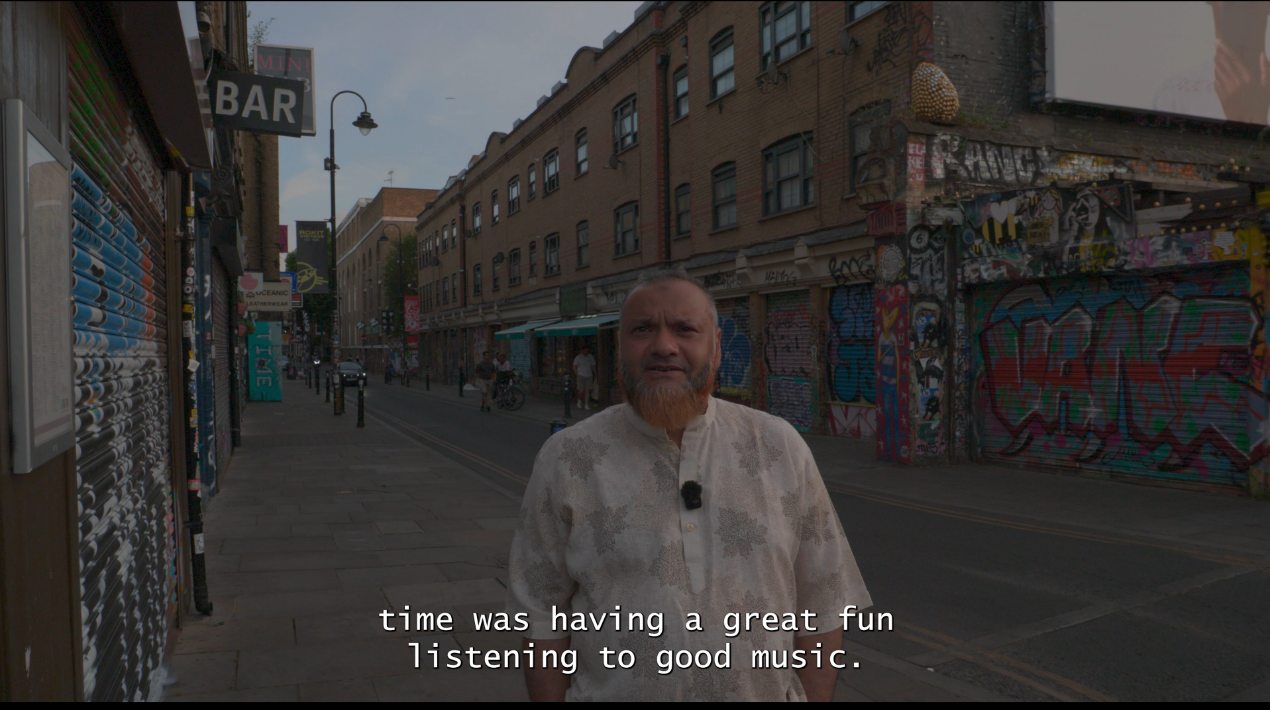
The first testimony is Abdul’s, who used to visit Brick Lane. In fact, he grew up in Kent, and the street belongs to his memory of arriving in Britain and seeing London for the first time. His earliest memory is of going there as a young boy with his uncle to do grocery shopping at Ali Brothers’ or Taj Store, since Brick Lane was where a Bangladeshi family could find produce from the country they left. He then moves to his teenage years, when there was no internet, and the street was where young Bangladeshi friends from across the country met to enjoy themselves, eat, and visit music and magazine shops such as Music House and Sangeeta. That time is warm in his account and bound up with friendship, which is the thread that reaches the present (figure 1). He identifies the beginning of the transformation after the year 2000, when living costs rose, some businesses closed, and many families moved away, though he adds that people still return to pray or for funerals at the mosque, which draws the community back together. As he recounts these memories, his relationship to the street shifts over time, since he is first a child shopping with his uncle, later a young man among friends, and finally an older man who returns to pray and see the friends of his youth. This movement is a clear example of what diachronic identity is, namely a self carried through time and held together by memory. This testimony is also autonoetic. As Abdul remembers the old Brick Lane, he places himself within it, since each memory belongs to a particular time in his life. Set against the street he sees today, those same memories show how far he has moved from that earlier self. In this way, his remembering is also a form of self-knowledge, since by recalling the old Brick Lane he comes to know who he has been and who he now is. Additionally, the fact that he remembers all this while standing in the street is what Casey (2000) would expect, as a place draws out the memories that belong to it. Finally, he claims that Brick Lane has changed for the better, now more varied and multicultural, while the street of his youth survives only through his memory.
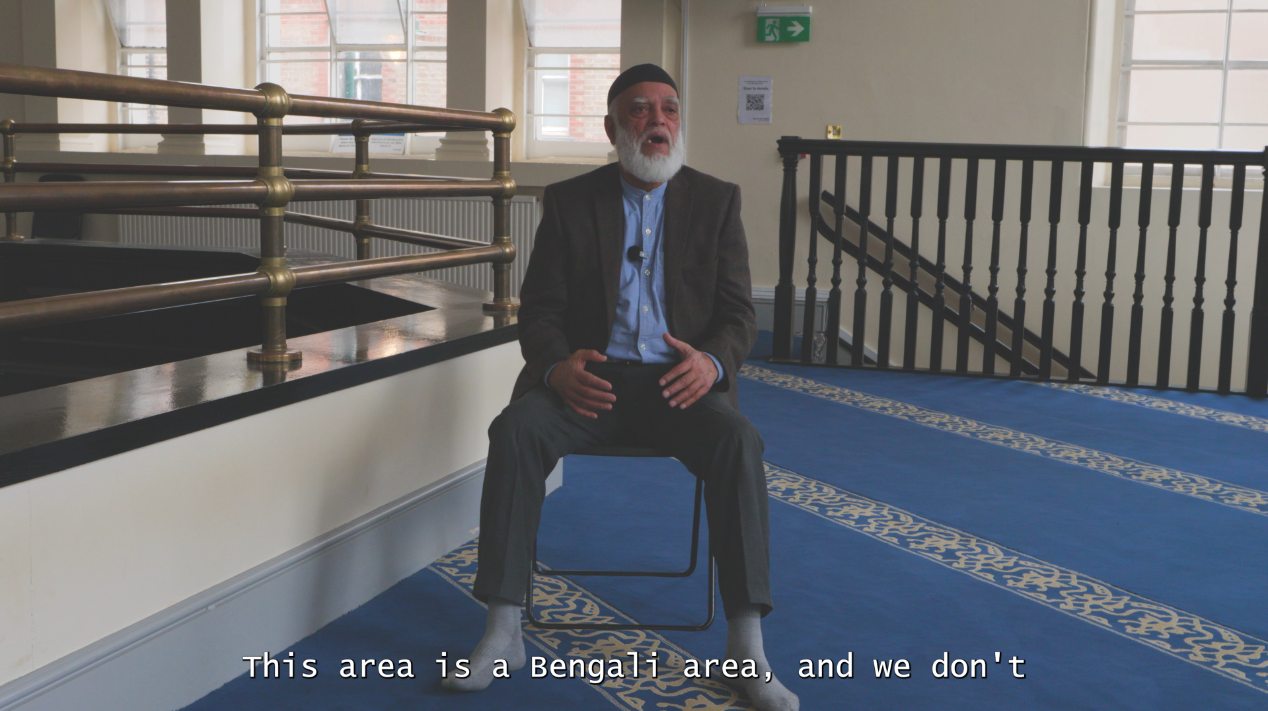
Abdul ends his testimony with the mosque, and the film cuts to it, where Rahman gives the second testimony from within the place itself. Where Abdul was a visitor, Rahman is rooted here, and he begins with the building rather than with himself. He recounts how it was first a church, then a synagogue, and finally, in 1976, a mosque, and how the Bangladeshi community around it had nowhere nearby to practice their religion. He identifies with the mosque, using its history to situate himself. He then recalls that when he came to the country in 1968, there was nowhere to pray, and he felt, with others, the need to have one, which marks the beginning of his involvement with the mosque. He also recalls how the area was full of factories, especially tailoring ones, and most importantly, he speaks of the racism of the 1970s and the hostility that made those years hard, as well as the struggle it took to establish themselves, affirming that Brick Lane is a Bengali area (figure 2). He notes that the Jewish community faced the same racial abuse in Brick Lane before them, signalling how two different diaspora communities have made a place for themselves on the same street against the same difficulties. Rahman then turns to the present, which he too judges positively, since the area is now mixed, the various communities understand one another, and the racial conflict of the past is gone. However, he adds that many people moved out of the area, but that they come back every Friday to pray, which confirms the mosque as the place that, according to these two accounts, holds the community’s memory and brings it back together. Rahman’s identity moves through time along the history of the mosque and the struggle he lived through, and it arrives in a present he measures against that past, valuing that the fight for a mosque and against racism has paid off, since what he once faced is now behind him. This is his diachronic identity, and the testimony is autonoetic, since in recounting the mosque’s past and his own part in it, Rahman comes to know who he has been and who he is. To conclude, the mosque is the place his memory gathers around, drawn out of him as he sits within it, which is the dependence of memory and place Casey (2000) describes. Placed side by side, the two testimonies show what Hall (1994) means when he says a shared culture contains both difference and likeness. Indeed, Abdul and Rahman belong to the same diaspora, but their experiences of Brick Lane come from different positions within the community. Abdul came from outside, and his Brick Lane is a place he identifies with memories of his uncle and friends from his youth. Conversely, Rahman was rooted there, and his memory of the street coincides with the mosque he helped to build and the struggle that surrounded it. The film, thus, does not resolve this difference into a single account of the community, since doing so would be to claim the objectivity it has refused from the start. It holds the two positions together and lets them meet only on the one point they share, namely that the mosque keeps a scattered community coming back.
The film ends at dawn, on an almost empty Brick Lane, with the call to prayer sounding across it. Both men named the mosque as what draws people back, so the adhan carries the community’s memory and calls it up as it sounds. Throughout the film, the viewer has been held in the interstice between what is heard and what is seen, as the testimonies describe a Brick Lane the film never shows. As a result, the ending fills the gap by doing openly what the viewer has done in private, since as the adhan sounds, archival footage of the community rises through the present street, giving the remembered past an image at last. The past that first entered as still photographs now returns in motion.
Conclusion
With this project, I set out to test an idea through practice, namely that a community builds and rebuilds its identity in the act of remembering instead of simply inheriting it whole. As I mentioned in the introduction, during the fieldwork, the people I spoke to held contrasting views of Brick Lane. Indeed, some remembered decline while others saw improvement compared to the past, confirming that there could be no single monolithic account of their identity and memory, only a set of positions held by different people. As a consequence, speaking for the community as a whole would flatten them into one, so I decided to explore two different, particular positions by refusing to speak over them.
Each of the three thinkers I employed shaped a decision about the film. Hall (1994) argues that we always speak from a particular position, so a film about memory speaks from one too, and Memories of Brick Lane had to make my position part of what it shows, by dropping any pretence of neutrality and objectivity. Assmann (2015) describes memory as something built in communication, so a testimony is memory produced in the act of speaking in the moment of the encounter. The film was made to hold that exchange, filming each participant from the position I spoke to them. If the first two decisions concerned my positionality, the third concerned the places themselves, since Casey (2000) argues that memory depends on place, and so the film returns to where each memory belonged, for instance, the street where Abdul spent his youth and the mosque that Rahman helped to build, by treating them as what draws the memory out. What follows from this framework is the film’s form, and it is the form that carries what a written account could not, since the slow motion, the fades between each section, and the gap held open between what is heard and what is seen are themselves the means by which the argument is made through image and sound. In fact, contrary to an essay, a film does not describe how memory reaches across a severed past; instead, it performs it and asks the viewer to take part in the same act. Moreover, this project points beyond Brick Lane. Diasporic communities live in places that change around them over time, as buildings are put to new uses and the street assumes a different character than what is initially remembered. It follows that a community’s past cannot depend on place alone, but survives in the bond between people and the places they remember, with each person holding a part of it. The past belongs to the people who lived it, and a film cannot remember it for them. What it can do, and what I tried to do with this film, is make the work of remembering visible and, for a moment, bring it into the space between those who lived it and those who have come to witness it.
References
- Assmann, J. (2015). Memory: A history. Oxford; New York: Oxford University Press.
- Casey, E.S. (2000). Remembering: A Phenomenological Study. 2nd edn. Bloomington: Indiana University Press.
- Fengming: A Chinese Memoir (2007). Directed by Wang Bing.
- Grimshaw, A. and Ravetz, A. (2009). Rethinking observational cinema. Journal of the Royal Anthropological Institute, 15(3), pp.538–556. doi:10.1111/j.1467-9655.2009.01573.x.
- Hall, S. (1994). ‘Cultural Identity and Diaspora’, in Williams, P. and Chrisman, L. (eds.) Colonial Discourse and Post-Colonial Theory: A Reader. London: Routledge, pp. 392–403. doi:10.4324/9781315656496.
- Koyaanisqatsi (1982). Directed by Godfrey Reggio. Los Angeles: Island Alive.
- MacDougall, D. (1998). Transcultural Cinema. Princeton: Princeton University Press.
- MacDougall, D. (2006). The Corporeal Image: Film, Ethnography, and the Senses. 1st edn. Princeton: Princeton University Press.
- Rascaroli, L. (2017). How the Essay Film Thinks. New York: Oxford University Press.